Back to Our Thinking
Competence Lives on the Other Side of Fear: What Michelle Obama Taught Us Last Week
May 26, 2026
On courage, confidence and why the women who’ve “made it” are still asking “am I good enough?”
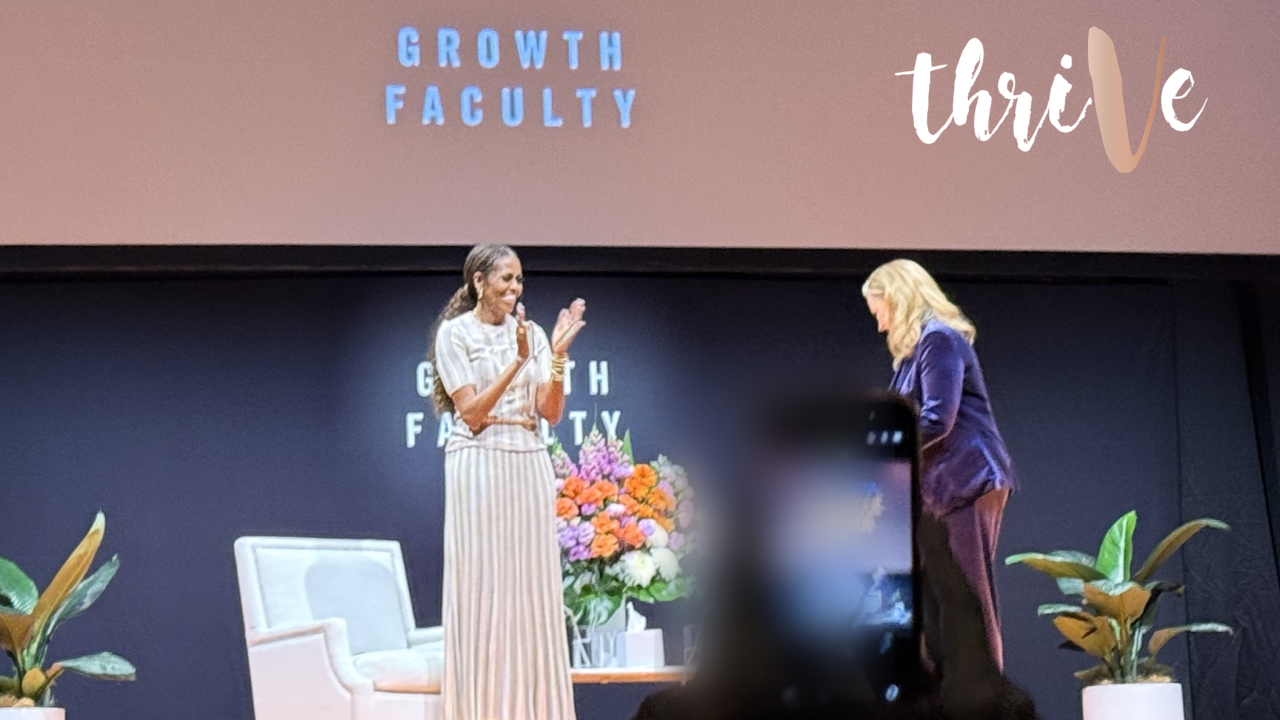
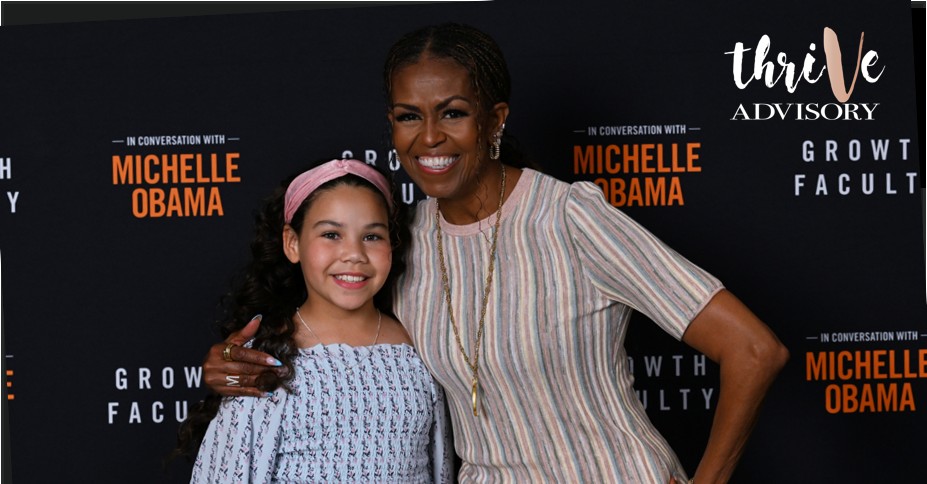
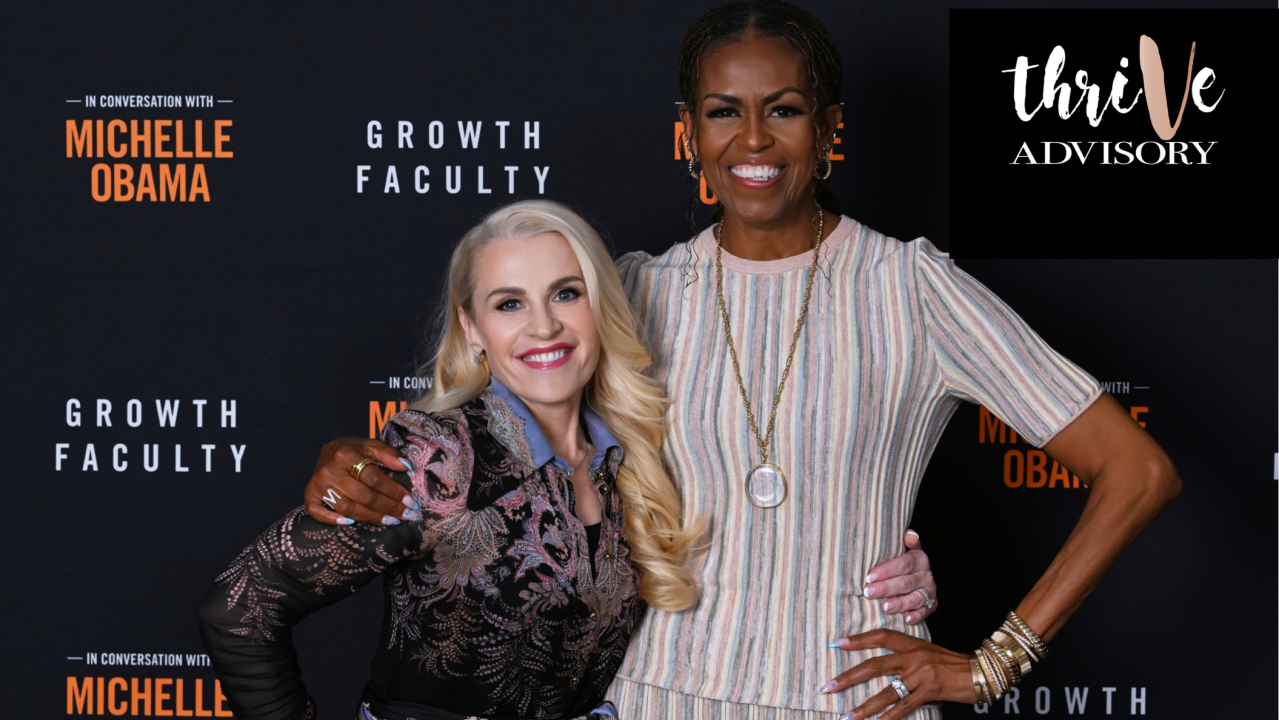
Last week, we had the extraordinary privilege of meeting Michelle Obama and hearing her messages and advice at the ICC Sydney. In conversation with broadcaster Leigh Sales, she was brilliant, generous, funny and disarmingly candid. She spoke about her childhood, including living with her father’s MS, pivotal moments related to her education, career and parenting, the road to the White House and what has come after, including her continued global advocacy for empowerment and equality and the extent to which she is relishing her freedom and owning her wisdom in this phase of her life. A clear thread throughout her personal anecdotes and advice linked to what it takes to move through life with courage and conviction, including the very human forces that conspire to stop us.
For those of us who work with senior leaders and their organisations every day, the resonance was immediate and profound. This is the first in a series of articles drawing on her insights, her books Becoming and The Light We Carry and our own research. We begin where Michelle began: with fear and what lives on the other side of it.
Competence sits on the flip side of fear
When asked about one of the most striking lines in her book The Light We Carry – that competence sits on the flip side of fear – Michelle traced it back to her mother’s parenting philosophy. Marian Robinson was not, she explained, raising children. She was raising human beings.
“She parented in that way. At four we had alarm clocks, because she felt like our education was our responsibility. I remember my first day of kindergarten, she took me to school and the next day she said: okay, you’re on your own. And I thought, wow, this lady is crazy. But she was telling me that I was capable. That she trusted my capability. And even though I was terrified, I did it – and there was just a sense of ability and competence.”
— Michelle Obama, Sydney, May 2026
The insight that follows is deceptively simple and yet cuts against so much of contemporary parenting and, we would argue, contemporary leadership culture. When we protect people from fear, we inadvertently rob them of the experience of moving through it and extracting the key lessons to aid in future challenges. It is only by moving through fear, not around it, that we build genuine competence and the belief that we can navigate fear, anxiety and other challenging emotions.
This aligns closely with what Harvard Business School Professor Amy Edmondson shared with our Thrive Advisory community last November: that parents and leaders, with the best of intentions can end up making those they seek to protect “more risk averse, more fragile and ultimately more unsure in a way they didn’t intend at all.” The parallel between parenting and leadership is not incidental. It is structural.
Fear is something you have to practice through
What makes Michelle’s account of fear so compelling is that she doesn’t theorise it from a distance. She maps it across the pivotal moments and specific, courageous choices of her own life: walking to school by herself from the second day of school at age 5 and catching an hour-and-a-half bus ride alone in the dark at 5:30am to access a better high school as two of the most profound examples she shared from her formative years. She progressed to describe her experience arriving at Princeton as one of a handful of Black students in a sea of privilege, living down the hall from the son of the Governor of New Jersey and surrounded by other students arriving in limousines.
Each of these moments was a choice point – a moment where retreat would have been rational and understandable and where pressing forward required something harder than courage in the abstract. It required the accumulated practice of taking the first step, pressing forward through fear, trusting she could handle all that came her way each and every time.
“If I hadn’t done that and hadn’t practiced that early,” she reflected, “then all the other firsts that I was going to experience might be things I would walk away from, I’d run away from. Instead, I learned to lean in.”
“I’ve learned that sometimes you just have to wait through the fear and be patient with yourself. One of my tools is patience. And time.”
— Michelle Obama, Sydney, May 2026
Her anecdotes and advice resonated deeply for the Thrive Advisory team across all personal and professional spheres of our lives. For our clients navigating career-defining transitions – a step-up to CEO, a first Board appointment, a move into a new market or a new country – this framing is one we return to again and again in our coaching work. The capacity to sit in the discomfort of new is a muscle and it is built through repetition. The executives who move most fluidly through transitions are rarely those who feel no fear. Rather, they are those who have learned how to recognise, label and develop a working relationship with it while simultaneously supporting others to navigate the fear that so often accompanies change.
Four words that define a life: “Am I good enough?”
One of the most searing moments of the evening came when interviewer Leigh Sales noted that Michelle had written in The Light We Carry about four words that have defined her life – and that she knew, before Michelle said them aloud, what they would be. Because they were the same four words she would have chosen for herself.
Am I good enough?
Michelle’s answer was neither a reassurance nor a pep talk. It was an analysis:
“We live in a world of comparison and contrast. We live in a world that is racist and misogynist and homophobic. Self-doubt is intentional. There are people in power that don’t want folks to feel good about themselves… that’s not on us. That’s by design. So my question would be: why on earth would we feel good enough?”
— Michelle Obama, Sydney, May 2026
This is not despair. It is clarity. And it is a reframe that matters enormously for women and for the organisations that are serious about attracting, developing and retaining them.
The Gender Lens: when confidence becomes a weapon
Michelle’s observation is backed by some of the most thought-provoking recent research on gender and the workplace. In a 2022 HBR study, organisational researchers Darren Baker and Juliet Bourke found something that should give every leader pause: confidence is not just gendered – it is weaponised against women.
In their in-depth interviews with 66 senior leaders across Accounting and Finance, they found that the vast majority of women (33 out of 36) identified a lack of confidence as a central factor obstructing their own career progression. Yet not one of the 30 male leaders cited confidence as relevant to their own trajectories. When men raised the topic, it was only ever in relation to women.
More troublingly, the research revealed a double bind with no clean exit: women who display low confidence are penalised for failing to advocate for themselves, while those who display high confidence risk being perceived as overcompensating, aggressive or “trying to be one of the lads.” As one male leader in the study opined: “I find our women lack self-confidence because they undersell themselves.” Another described a woman who was “clearly acting a role” when being assertive.
“Women are walking an enervating tightrope of exuding just the ‘perfect’ amount of self-confidence: a psychological challenge men rarely face.”
— Baker & Bourke, Harvard Business Review, 2022
The downstream effect is a downward spiral: feedback that attributes women’s slower progression to confidence deficits leads to self-criticism and self-blame, which further erodes self-belief — and so on. Critically, Baker and Bourke argue that this focus on individual confidence as a strategy distracts leaders and organisations from the structural barriers that actually matter: stereotyping, role design and the systematic undervaluing of functional roles that women disproportionately occupy. This is an example of the type of “blame or fix the women” trap in contrast to seeking to support women while addressing systemic bias and challenges at team, organisational and societal levels that deleteriously impact women in the workforce that I wrote about in my doctoral dissertation 20 years ago.
Michelle shared her personal experience and observation of others, namely that for many women, she observed, it takes until their sixties to realise that the self-doubt was always a lie:
“For a lot of women, I think it takes us until this age to sort of realise, oh my God, I kind of knew what I was doing all along!”
— Michelle Obama, Sydney, May 2026
And then, without missing a beat: “What is going on?”
It is a line that drew laughter in the room. It also landed with the quiet weight of something that we imagine many women in the audience had never quite allowed themselves to say aloud.
Owning wisdom – finally
At 62, Michelle described feeling – for the first time in her life – that she can own her wisdom. It is a moment of arrival she did not rush or diminish.
“I think that’s something that we, as women, it takes us a while before we feel like we can own what we know. Whereas men… you guys are claiming your wisdom at like 30! We have to live a life. And now that I have a life I can look back on, I can point to the things that I got right – my instincts, the decisions I made. I’m trying to sit in that truth, as opposed to brushing it away.”
— Michelle Obama, Sydney, May 2026
This is not a small thing. For the high-achieving women we coach and work alongside – women with extraordinary track records, who have navigated genuinely hard things and done so with rigour, grit and grace – the capacity to own that track record, to sit in it rather than deflect it, remains one of the most difficult leadership development edges we encounter. The habit of self-diminishment runs deep.
The Thrive Advisory Lens
In our coaching work, we see this play out when supporting senior women and when being provided with coaching briefs and 360 Feedback. We see it in the data from our own Leadership Insights Research, where courage – including the courage to claim one’s own authority – emerged as a critical and frequently underdeveloped leadership capability, especially under pressure.
We wrote about this topic late last year, in this article on Coaching for Courage, which cited elements of our research. In our Leadership Insights Research (2019) we interviewed and surveyed 715 leaders and Board Directors and gathered 13,000 comments on a diverse range of leadership topics. When asked what leadership competencies and skills are required to successfully respond to key internal and external challenges, courage emerged as the 8th most critical competency to respond to key internal changes and challenges and the 9th most critical competency to respond to key external changes and challenges our participants were facing in their organisations. When asked to articulate a personal view on the three biggest leadership ‘derailers’ or ‘Achilles heels’ that most detract from leadership potential and impact, a lack of courage emerged as the 8th most prominent derailer.
In our Covid-19 Leadership Research (2021) when asked to identify the one leadership competency they were seeking most from their leaders over the next 12 months, 47% of our 505 participants highlighted courage and candour.
More recently, in our ongoing Future of Leadership Research, the Thrive Advisory team have collected and analysed over 2 million data-points related to leadership competencies required for the future from a broad array of sources including peer-reviewed journal articles and meta-analyses, books and articles from global thought leaders, discussions with clients, colleagues and peer Leadership Advisory firms and leadership predictions made by renowned academics, leadership experts and futurists. The sources were content coded for themes and courageous leadership, candour and the ability to navigate conflict emerged as the 11th most prominent leadership capability cited as critical for the future.
More broadly, across our CEO succession and talent assessment work, we observe the fear-competence dynamic playing out at every level of the leadership pipeline. We regularly encounter senior executives – disproportionately women – who are held back less by capability gaps than by the architecture of self-doubt that Baker and Bourke describe: an internalised belief that they must be more certain, more polished, more ready than their peers before raising a hand.
What Michelle’s journey illustrates – and what our research and practice consistently affirm – is that courage and confidence are not a prerequisite for action. They are consequences of it. The executives who build the most durable self-belief are those who have accumulated what she describes: a series of moments in which they chose the bus, chose the Ivy League, chose the terrifying thing and came out the other side having surprised themselves.
Baker and Bourke’s call for organisations to declare a moratorium on the word “confidence” in feedback and performance conversations is provocative – and we believe it is worth contemplating seriously. If the confidence narrative is being weaponised against you or other women in your organisation, however inadvertently, it is not a coaching problem. It is a leadership and system design problem – and it requires a leadership and system design response.
Reflection Questions
If key tenets of this article resonate with you, we encourage you to consider the following questions:
- Where in your personal or professional life is fear currently operating as a stop sign rather than a signal? What would it look like to treat that fear as information rather than instruction?
- Think of the last time you sat in genuine discomfort – a new role, a hard conversation, a stretch assignment. What did moving through it teach you about your own capability?
- When you consider how you have moved through similar fear, courage and confidence challenges, what advice would you extract for others? How could you pay it forward and share those insights?
- For the women reading this: where are you still waiting to feel “ready enough” before claiming your seat, your voice or your accomplishments? What would it mean to own your wisdom now?
- For all leaders, where might your language in feedback, performance or promotion conversations be – however unintentionally – contributing to the confidence double bind for women in your team or organisation?
- What is one courageous choice available to you right now – in your career, your leadership, your life – that fear is holding at arm’s length? What is the first small step through it?
We are deeply grateful to Michelle Obama for an evening of extraordinary candour, warmth and provocation. And to the many women in that room – and beyond – who heard the words am I good enough and recognised themselves: the research says the self-doubt was never the truth. The competence was always there. It was waiting for you on the other side of the fear.
A sincere thank you to Karen Beattie and Aimee Rydberg at the Growth Faculty for curating this incredible experience for each of us. Kudos and congratulations Karen for bringing your vision to life and ensuring Michelle’s powerful messages and advice were shared with your Australian audience!