Back to Our Thinking
Coaching for Courage: Replacing Fear with Frankness
December 4, 2025
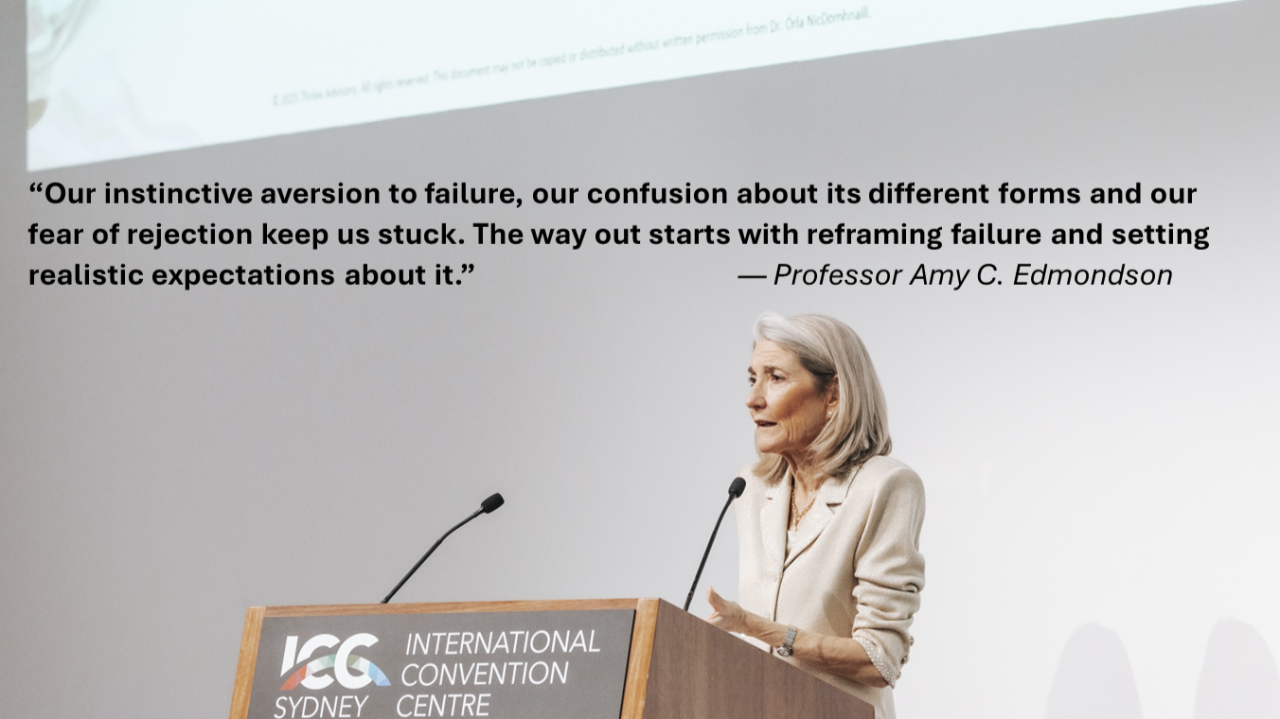
Since our Fireside Chat with Professor Amy Edmondson at WOBI last month, we have been reflecting on so many challenges our clients face, the diverse concepts we explored and the pragmatic suggestions she shared. We discussed the concepts of fear and frankness as they relate to both psychological safety and intelligent failure and the types of leadership and mindsets we need to allow us overcome various forms of fear in our personal and professional spheres.
During our Fireside Chat and in her article titled The only thing to fear is unproductive fear, Professor Edmondson explores how fear can both paralyse and, when channelled toward legitimate concerns, fuel effective action and innovation. She warns of the tragedy of letting fear dominate, noting that the key for today’s leaders is to recognise the difference between “problematic fear” and “productive fear.” She describes how fear triggers an “action tendency”, which is the instinct to withdraw or distance ourselves from perceived threat. At its core, fear activates self protection: a spontaneous, sometimes healthy, human response.
Drawing on evolutionary psychology, Professor Edmondson explains that humans are hard-wired with “prepared fears”, those instinctive fears passed down from our evolutionary past. These often no longer serve us. In the workplace, she highlights how the fear of being ostracised can make employees less effective, leading people to withhold ideas, questions and concerns, thereby limiting the innovation and collaboration essential to a knowledge economy. She suggests “Our observations or ideas just might be the crucial data that shift the course of a risky project for the better, but our spontaneous emotional wiring has not re-adjusted for the modern world.” Professor Edmondson concludes that “much workplace fear could be categorised as irrational, in that our lives are not at risk, yet our physiological response mimics that of life-threatening stimuli.”
In another article Professor Edmondson outlines how fear inhibits learning, citing research shows that fear consumes physiological resources, diverting them from parts of the brain that manage working memory and process new information. Importantly, she notes fear inhibits learning from failure, noting “It is hard for people to do their best work when they’re afraid. It’s especially hard to learn from failure because doing so is a cognitively demanding task.”
Overriding Problematic Fear
To override prepared fears, Professor Edmondson urges each of us to learn how to challenge our initial responses and identify more productive responses. She features psychological research showing how unexpected stimuli which provoke fear can also trigger curiosity, suggesting “when we force ourselves to be curious rather than certain (that a target is frightening and should be escaped from), we become capable of considering our options more thoughtfully.” She argues that finding paths to move toward rather than away from the “threat” with the aim to understand it better is an opportunity for creative action. She provides a call to action for leaders, pointing out that to garner the benefits of recognising and responding appropriately to workplace fears, leaders must intentionally surface and manage them. She concludes by sharing “the power of productive fear in motivating us to face real threats calmly and creatively is immense – but only if we can reduce the problematic fears that hold us back.”
The Criticality Of Courage
As we reflect on Professor Edmondson’s advice, our research and those of others, we believe it is critical to spotlight the role of leaders in role modelling courage and bravery and encouraging others to choose courage and candour over comfort and frankness over fear. In Dr. Ranjay Gulati’s October 2025 HBR article on leadership courage, he frames bravery as a choice and defines courage as “a willingness to take bold, risky action to serve a purpose that you perceive to be worthy, usually in the face of an abiding fear.” He posits it can involve:
- Accepting a physical challenge
- Making yourself emotionally vulnerable
- Risking social or economic standing for your moral beliefs
- Publicly championing new and unorthodox ideas.
He cites FactSet research suggesting 76% of S&P 500 companies are citing “uncertainty” in their earnings calls (up from 37% in the three months prior) and argues that amidst the level of flux of our increasingly VUCA world, leadership courage is especially critical.
Professor Brené Brown has published extensive research and advice in this space and similar to Dr. Gulati, she suggests we consider bravery as a choice. In her Daring Greatly book, she asserts that great leaders lean into their vulnerability to create a safe space for their teams to have difficult and emotional conversations, proposing these leadership behaviours lead to psychological safety in the workplace. More recently, during her November 2025 podcast with Steven Bartlett she shared the following thoughts: “It’s not fear that gets in the way of us being brave with our lives. It’s the armour that we reach for to self-protect when we’re afraid. The hardest work is being aware of what my armour is when I’m afraid. Vulnerability is important if we want to be brave with our lives, but we were raised to believe that vulnerability is weakness. There is no courage without vulnerability because courage is the willingness to show up and be all in when you cannot predict the outcome.”
We are in full agreement! In our consulting, coaching and research, we are seeing the criticality of courage becoming increasingly evident across time, settings and sectors. Courage has emerged as a critical leadership capability across Thrive Advisory’s three largest leadership research initiatives. In our Leadership Insights Research (2019) we interviewed and surveyed 715 leaders and Board Directors and gathered 13,000 comments on a diverse range of leadership topics. When asked what leadership competencies and skills are required to successfully respond to key internal and external challenges, courage emerged as the 8th most critical competency to respond to key internal changes and challenges and the 9th most critical competency to respond to key external changes and challenges our participants were facing in their organisations. When asked to articulate a personal view on the three biggest leadership ‘derailers’ or ‘Achilles heels’ that most detract from leadership potential and impact, a lack of courage emerged as the 8th most prominent derailer.
In our Covid-19 Leadership Research (2021) when asked to identify the one leadership competency they were seeking most from their leaders over the next 12 months, 47% of our 505 participants highlighted courage and candour.
More recently, in our ongoing Future of Leadership Research, the Thrive Advisory team have collected and analysed over 2 million data-points related to leadership competencies required for the future from a broad array of sources including peer-reviewed journal articles and meta-analyses, books and articles from global thought leaders, discussions with clients, colleagues and peer Leadership Advisory firms and leadership predictions made by renowned academics, leadership experts and futurists. The sources were content coded for themes and courageous leadership, candour and the ability to navigate conflict emerged as the 11th most prominent leadership capability cited as critical for the future.
Cultivating Courage
Similar to Professor Brené Brown, Dr. Gulati’s encourages us to consider bravery as a choice. In his article he:
- Proposes the relevance of the old adage, highlighting research that demonstrates that fortune favours the bold, not the cautious
- Argues that in our VUCA context, courage is being increasingly critical
- Opines on the nature vs nurture debate, citing research that suggests courage can be cultivated
- Shares examples of how prominent global leaders such as PepsiCo’s Indra Nooyi and BlackRock’s Larry Fink acted with courage
- Features his ongoing research in the space and offers five strategies to drive bold action amidst uncertainty.
With his colleagues Nitin Nohria and Franz Wohlgezogen he examined data related to the 2008 financial crisis and how 4,700 public companies had navigated the three previous recessions. They discovered that approximately 9% were able to “emerge from each downturn in stronger shape than before, not just because they thoughtfully cut costs but also because they simultaneously took calculated risks to invest in growth. Without intending to, they documented the significant difference that courage makes in business.”
He quotes Nelson Mandela famous quote: “courage is not the absence of fear but triumph over it” and outlines how under volatile, uncertain, complex and ambiguous (VUCA) conditions, when possible outcomes are unknown, most people feel a loss of control, triggering fear, which often leads to paralysis (the so-called freeze response) or retreat (flight). He posits that brave leaders, by contrast, are able to reclaim their agency and fight. Drawing from his archival research and data from the 200+ interviews he conducted with leaders, he offers the following strategies to draw from.
Strategy 1 is focused on creating a positive narrative which can include ways to:
- Go risk hunting, focusing on identifying and mitigating the challenges and threats you face
- Find a moral quest
- Call upon your faith, fate or your own belief system
- Craft a narrative to either lessen or overcome fear.
Strategy 2 is focused on ways to cultivate confidence via self-efficacy, crediting the work of the late Stanford psychologist Professor Albert Bandura who defined it as “what you believe you can do with [the skills] you have under a variety of circumstances.” Developing deep competence in their everyday work helped Dr. Gulati’s research participants feel better equipped to tackle complex and ambiguous challenges. They also enhanced their sense of self-efficacy using these three key tactics:
- Train deliberately.
- Assemble a large tool kit.
- Focus on what’s in your control.
Strategy 3 urges us to focus on sensemaking and taking small steps via a process where you resist the urge to equate bold action with big moves and instead:
- Take small steps to gradually gain more clarity about your situation
- Let go of the need for a perfect plan and open up to possibilities, trusting that the path will emerge as you proceed
- Evaluate objectively
- Let meaning emerge
- Interpret in motion and pivot accordingly.
Strategy 4 urges leaders to find and leverage connection, encouraging us to:
- Turn to allies for an emotional boost
- Access resources
- Accept feedback.
Strategy 5 focuses on emotional regulation and covers strategies to:
- Stay calm
- Practice self-care.
- Embrace rituals.
- Reframe the situation.
Coaching for Courage: Your Call To Action
Reviewing this combination of research is so perfectly timed! As we reflect on our year, it is timely to pause to consider where we have been courageous and the benefits of choosing courage over comfort in a holistic way. Of equal import, we can use this time of year to consider where greater courage could have served us and others more and how we might make different choices in 2026, committing to action and charting the benefits of experimentation and iteration in this regard.
- As you reflect on 2025, what are you most proud of from a courage and candour perspective? Where has your bravery paid off personally and professionally? In what ways have you or others benefitted from your courage?
- In what ways might you stretch yourself further in this regard in 2026? How would you know you have been successful in this regard?
- How might you coach others for courage and candour? What personal anecdote could you share with others to encourage them?